
Nine years after Grenfell, 64 of LBWF’s 65 low-rise and high-rise housing blocks are still not fire safe. How can this have been allowed to happen?
In 2020, after it was involved in several fire safety scandals, including litigation with a supplier, LBWF began a remediation programme (RP) to bring its housing stock ‘up to the most modern…safety standard’, this being forecast to cost £40m..
Previous posts on this blog have looked at the RP, and shown that in the early days there was some degree of progress, but more recently this has slowed.
Now, unpublished returns forwarded in April of this year by LBWF to the Regulator of Social Housing (RSH) confirm the trend.
The headline findings are that, as of April, 64 of LBWF’s 65 low-rise and high-rise blocks remained blighted by ‘life-critical fire-safety defects’; and in nearly a third of these cases, the ‘defects’ were both internal (such as ‘inadequate/defective fire doors’) and external, that is, about the cladding.
But what is especially striking is that previous returns had reported almost exactly the same thing, as the following tables illustrate:
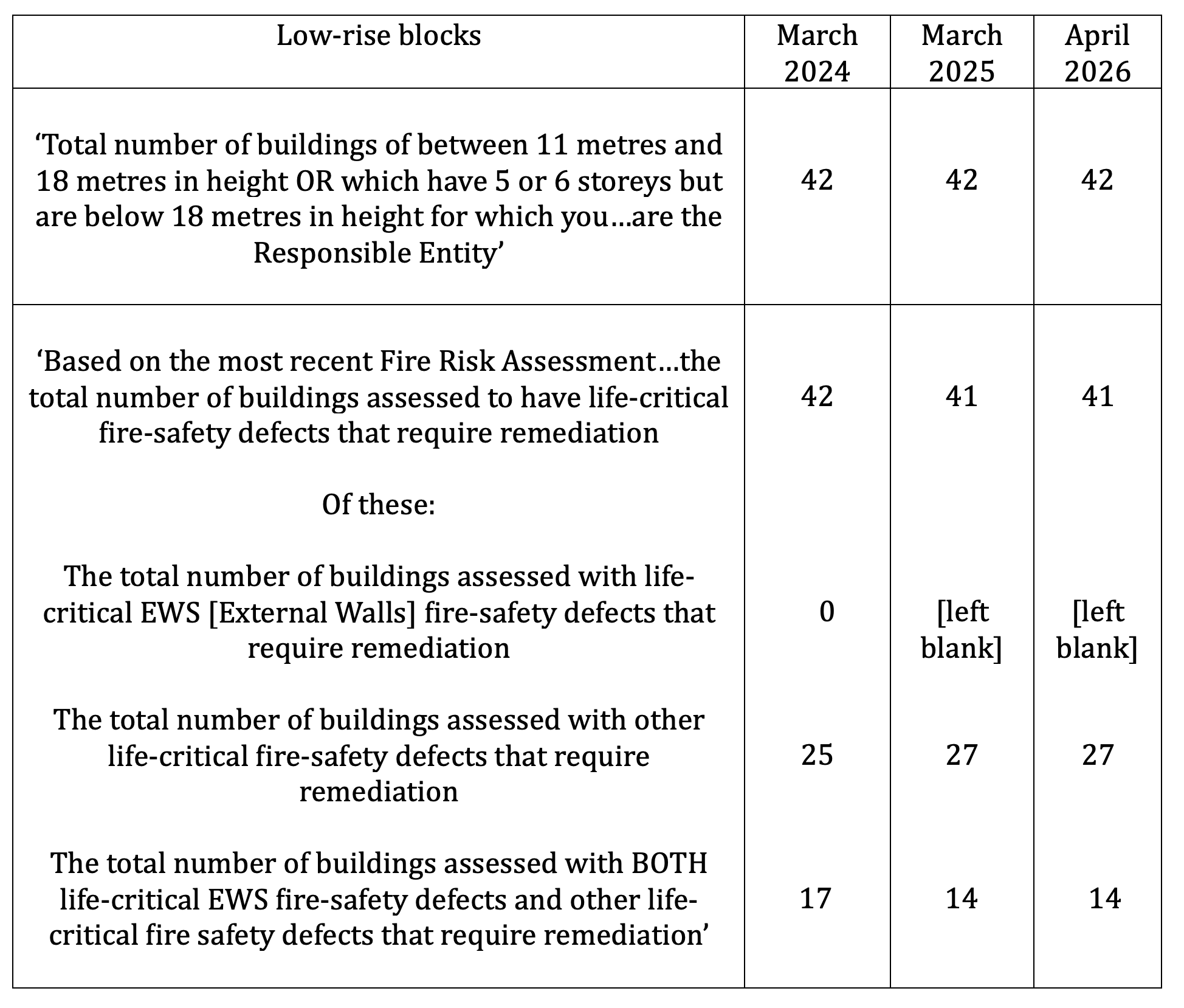
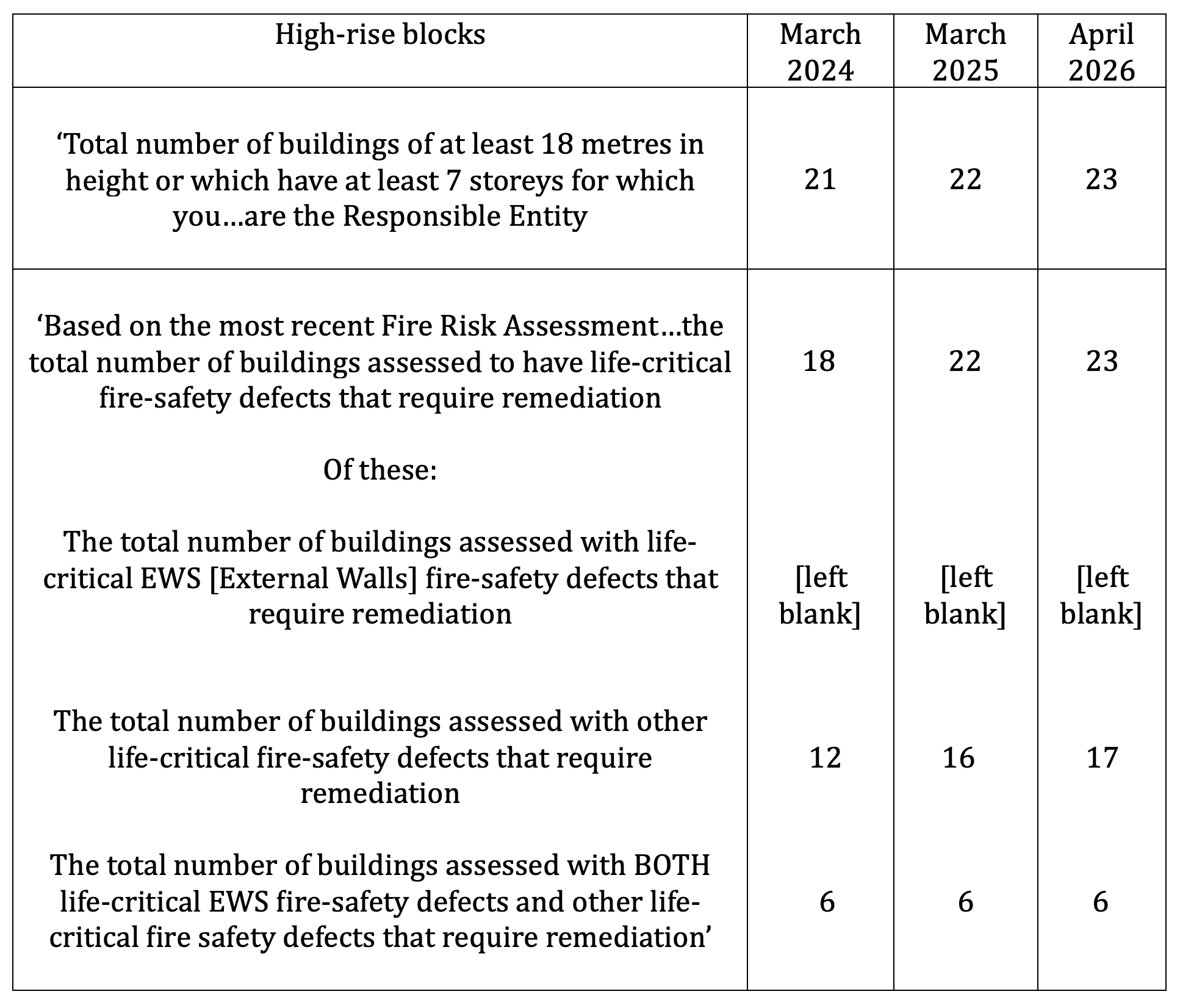
After the trauma of Grenfell, this lack of substantive change is shocking. How can it be explained?
It’s true that, to an extent, LBWF has been hindered by difficulties beyond its control. For example, the legislative framework governing fire safety in social housing blocks has become more complex over time, while during and after Covid, suitable construction companies were in short supply.
But it’s also true that LBWF’s own actions, or lack of them, have made matters worse.
In the years down to 2020, LBWF conspicuously failed to address many already identified fire safety issues in its blocks, and so the backlog of remediation work grew and grew. One estimate dating to the start of the RP was that, to make all the blocks fully fire safe at that point, LBWF would need to carry out about 7,000 separate ‘actions’.
That is a big ask in itself.
But in addition, as the RP has proceeded, there have been unexpected and unwelcome discoveries, issues that had quietly festered for years, and should have been identified long before.
Thirteen high-rise blocks were found to contain asbestos, in several cases requiring specialists to strip it out; when originally installed, a large number of windows had been packed with flammable timber, all of which needed replacing; and in a handful of cases, the blocks required new exterior cladding, something not envisaged in the initial scoping exercises.
Given all of the latter, it is unsurprising to find that the RP’s budget has become strained.
In 2024, the then Leader, Cllr. Grace Williams, stated that the sum committed had increased.
However, the annotations made in LBWF’s returns to the RSL suggest that, despite this apparent boost, monetary problems have persisted, with ‘resources’ and ‘available budgets’ cited as ‘barriers to delivery’.
Of course, spending decisions are in the end political choices, so why has underfunding occurred?
First, it should not be forgotten that, at the same time as LBWF has been running the RP, it also has been energetically pursuing a succession of other programmes and fads, principally collaboration with big property developers to deliver private flats; mini-Holland and active travel; fifteen-minute neighbourhoods; a new mission based approach to public service provision; and a large-scale internal equality, diversity, and inclusion programme.
It’s quite possible, then, that the RP has been crowded out, with key councillors and officers busy concentrating on what they see as politically more compelling priorities, and allotting budgets accordingly.
Second, it’s also apparent that there never has been much real pressure on LBWF to act any differently.
For whatever reason – ignorance, lack of curiosity, fear of the whips – only one or two councillors seem to have made any challenge.
It is surely telling that neither the Audit and Governance Committee nor the Housing Scrutiny Committee have discussed the RP since October 2022.
Outside of the Town Hall, the situation has been similar, albeit for different reasons.
A few have spoken out.
To their credit, several journalists, most obviously James Cracknell (the then editor of the Waltham Forest Echo) and Michelle Edwards, have publicly exposed LBWF’s cavalier approach to fire safety in its blocks.
In the same vein, resident Roy Sutton has long raised fire safety issues at the sheltered facility where he lives, and been threatened with eviction as a result.
But what’s notable is that, amongst activists and campaigning organisations, none seem to have shown much interest.
Take the local Left. At one time, it would have been all over this kind of issue, with petitions, protests, and calls for heads to roll.
But in the past few years, though the Left has been vociferous about aspects of identity politics, the threat from the ‘far right’, and of course Israel, its concern with the RP, and indeed fire safety in general, has been minimal, if that.
The conclusion is obvious.
Prime responsibility for the failure to make LBWF blocks fire safe unequivocally lies with the Town Hall leadership.
But those elsewhere who have averted their gaze are far from blameless.
