
The Whitefield Local Child Safeguarding Practice Review (2): more confusion and controversies
Further to an earlier post (see links) there are two additional points that are worth making about the contents of the Whitefield Local Child Safeguarding Practice Review (LCSPR).
The first concerns what appears to be some confusion about basic facts.
At paragraph 1.2, right at the start of the document, the LCSPR describes how, in 2014-17, children were locked in the ‘calming rooms’ for ‘prolonged periods of seclusion’, and subject to ‘inappropriate physical restraint’ and ‘other restrictive and harmful practices’.
Plus, it continues, this went on without attracting much, if any, attention:
‘The review found no evidence of direct concerns raised by parents, staff, support workers or other professionals’, adding ‘the inappropriate practices were not reported…to any professional or agency outside the school setting, during the three-year period’.
That seems very definite.
But subsequently, at paragraphs 2.6 and 2.7, the LCSPR recounts the following:
‘In 2015, one parent recalled raising concerns with the school regarding the use of restrictive practices, including the use of the [calming] rooms. Based on the information available to the review, these concerns were not escalated within and beyond the school or progressed through formal safeguarding or complaints processes’,
and then
‘Between 2016 and 2017, a number of concerns were raised regarding the use of seclusion and restrictive practices at the school, presenting several opportunities for greater external scrutiny and challenge. In July 2016, an independent review of local settings by the British Institute for [sic] Learning Disabilities’ (BILD) Centre for the Advancement of Positive Behaviour Support, commissioned by the local authority identified concerns about the repeated use of calming rooms in the school, particularly for a small number of pupils, and recommended a review of behaviour support arrangements’.
So, if these latter two paragraphs are to be believed, far from there being ‘no evidence of direct concerns raised’, it seems ‘a number of concerns’ were raised, including (at least) one each by a parent and BILD.
The second point worth making is that the LCSPR seems to be strangely selective about what actually happened at Whitefield.
Children at the school suffered two kinds of abuse.
The way that the ‘calming rooms’ were used was deeply unpleasant, and likely unlawful, as has been described.
But there were also instances where, in addition to the restraint and so on, children were physically assaulted, this being revealed by the BBC investigative reporter Noel Titheradge (sometimes in conjunction with File on 4 producer Annabell Deas) in three searing reports, one of 2021 and two of 2024.
Thus, in their report of 30 April 2024, ‘Special school pupils “tortured” in calming rooms, BBC investigation finds’, Mr. Titheradge and Ms. Deas included the following:
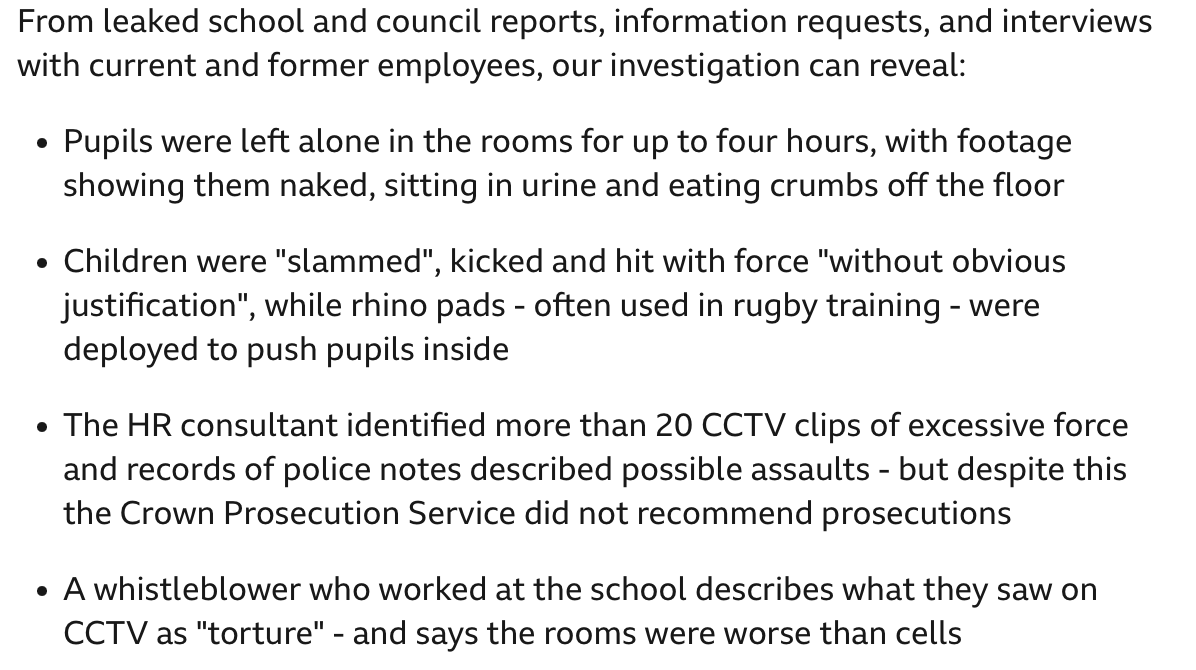
It might be thought that, given its remit, the LCSPR would deal at some length with both these kinds of abuse, but in fact its coverage is skewed to the former.
It’s true that there are references to violence at three points in the text, a vivid example being the observation that ‘Some parents reported noticing injuries to their children, including marks and bruising’, but there is no extended or detailed analysis of this issue as a whole.
The end product is that the LCSPR gives a somewhat unbalanced pictures of what went on, as this table illustrates:
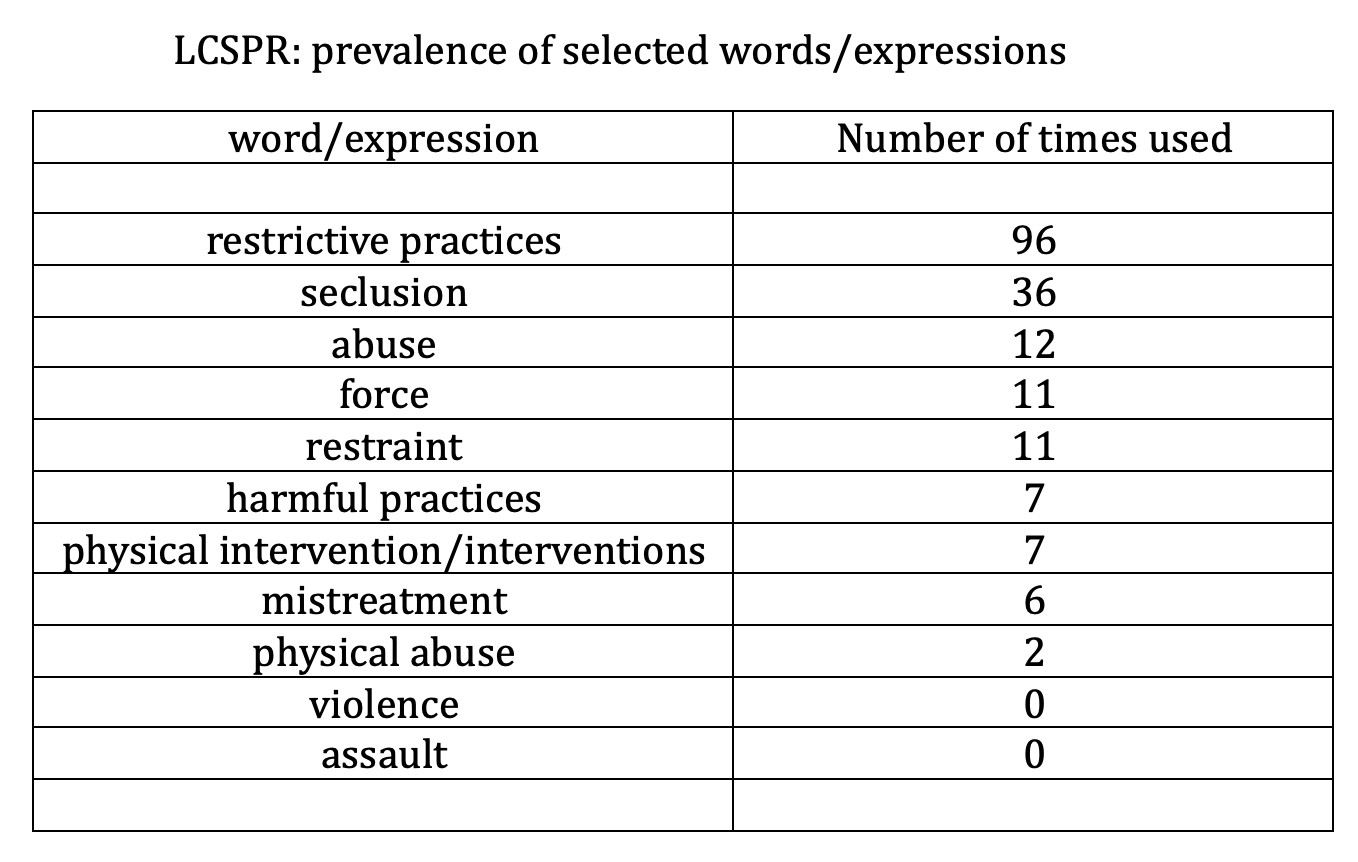
It’s unclear why the LCPSR adopts this approach, but it is revealing, and rather startling, that the LCSPR completely ignores the BBC reports, even in what is described as a ‘Chronology of key events’, despite them being widely discussed in the press, and commented on by both the Prime Minister’s Office and The Children’s Commissioner.
What’s clear though is that the focus used detracts from a full understanding what some of the abused children at Whitefield went through, and seems an odd way to treat those who suffered violence and their families.
The bottom line, therefore, is that the LCSPR is by no means the final word that its authors and the big wigs in the Town Hall no doubt hoped for.
Indeed, the more it is studied, the more unsatisfactory it seems.
