
Fifteen reasons why the Whitefield Local Child Safeguarding Practice Review is not fit for purpose
The Local Child Safeguarding Practice Review (LCSPR) about Whitefield seeks to address ‘two central questions’, which are ‘How and why these events occurred?’ and the contingent ‘How can the WF SCP [Waltham Forest Safeguarding Children Partnership] be assured that improvements in multi-agency practice and systemic changes since 2017 have significantly reduced the likelihood of recurrence?’ (para. 1.21).
What follows concentrates on the first of these questions, and shows that the answers which the LCSPR offers seem flawed.
The evidence which supports this conclusion is summarised under four broad headings.
1. Data problems
In discussing important details, the LCSPR is imprecise, making its judgements difficult to assess.
For example, the LCSPR states that:
(a) there had been ‘extensive engagement with families’ (para. 1.25) without specifying the number of families, or explaining what ‘extensive’ in this context means;
(b) evidence had been gathered from ‘key stakeholders’ (ibid.) without specifying who these are; and
(c) the ‘overwhelming majority of children who entered the school had already been assessed as having special educational needs (SEN) and had been issued with a Statement of SEN (pre-2015), or an Education, Health, and Care Plan (EHCP from 2015)’ (para. 1.8), without explaining where this information came from, in particular whether the certifications for all 350 pupils at the school had been checked, or whether it was just what someone claimed.
(NB This is a more critical issue than it may appear at first sight because EHCPs are an important way of measuring children’s wellbeing and progress; LBWF had a poor record of providing EHCPs at this time; there is some evidence that in 2014-16 Whitefield EHCPs were either missing or not being reviewed annually as the law required; and this may have been one reason why the abuse meted out to children remained hidden prior to the Ofsted report in January 2017).
2. Contradiction and uncertainty about basic facts
2.1. The first time that concerns were expressed about child abuse at Whitefield
At para. 1.2, right at the start of the document, the LCSPR describes how, in 2014-17, children were locked in the ‘calming rooms’ for ‘prolonged periods of seclusion’, etc. and adds ‘The review found no evidence of direct concerns raised by parents, staff, support workers or other professionals’, adding ‘the inappropriate practices were not reported…to any professional or agency outside the school setting, during the three-year period’.
But subsequently, at paras 2.6 and 2.7, the LCSPR recounts that ‘In 2015 one parent recalled raising concerns with the school regarding the use of restrictive practices’; and ‘Between 2016 and 2017, a number of concerns were raised regarding the use of seclusion and restrictive practices at the school, presenting several opportunities for greater external scrutiny and challenge’, going on to describe how in mid-2016 LBWF had commissioned the British Institute of Learning Difficulties (BILD) to produce a report on Whitefield’s practices, this had expressed concern about the ‘calming rooms’, but then LBWF had withdrawn the report because Whitefield threatened legal action.
2.2 The Metropolitan Police Force (MPS) and the Crown Prosecution Service (CPS) involvement over Whitefield
At para. 1.27, the LCSPR deals with MPS and CPS involvement over Whitefield as follows:
‘A three year criminal investigation by the Metropolitan Police followed the discovery of CCTV footage in 2021. Although evidence indicated that common assault and battery had occurred, the review understands prosecution was not possible because the six month statutory time limit had expired before the matter was reported to police. The police sought charges of child cruelty against school staff, school leaders, and the local authority; however, in July 2024, the Crown Prosecution Service concluded that the evidential threshold had not been met, as there was insufficient evidence that actions or omissions were “wilfully” cruel, a required element of the offence’.
However, when answering a Freedom of Information inquiry in mid-2025, the MPS provided a rather different account, particularly as regards dates, and the nature and extent of the investigations:
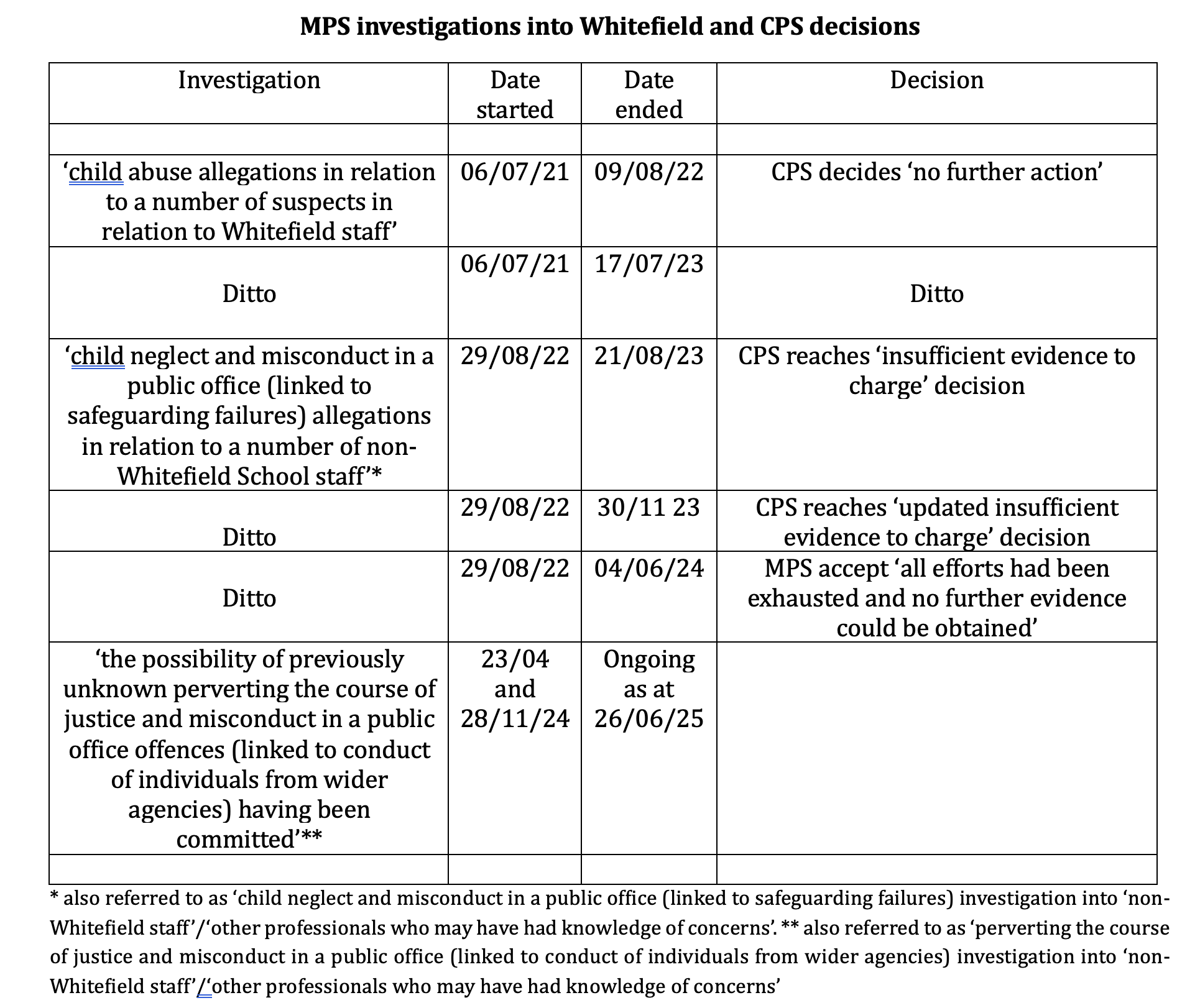
Did the LCSPR err here? Or was the MPS wrong?
2.3 The joint operation under Chapter Eight of the London Safeguarding Children Procedures
In May 2021, LBWF and the MPS launched a joint operation under Chapter Eight of the London Safeguarding Children Procedures (LSCP) into ‘organised and complex abuse’ at Whitefield.
The LCSPR does mention this briefly at para. 2.68, and states that it ‘provided strategic leadership parallel to the criminal investigation’, ‘supported coordinated multi-agency action’ of various kinds, and then was stood down in 2026 ‘once its functions had been fulfilled and all key responsibilities discharged’.
But that is by no means the full story.
For the prime focus of a LSCP Chapter Eight inquiry is emphatically not to provide strategic leadership or co-ordinate action, but to investigate the child abuse that has been reported to it.
And when that child abuse has been investigated, as para. 8.2 of Chapter Eight makes clear, those in leadership positions must evaluate that investigation, identify the lessons learned and ‘prepare an Overview Report with recommendations and an action plan for the local safeguarding partnership, highlighting any practices, procedures or policies which may need further attention and require either inter-agency or individual agency action plans.
That’s clear enough, but in the Whitefield case this remit – contrary to what the LCSPR states – was not fulfilled or discharged. For, as LBWF admitted in early 2025 when questioned under the Freedom of Information Act, during the five years that the LSCP Chapter Eight inquiry existed, no ‘written report’ was produced, and there were ‘no outcome reports/findings’ presented to either councillors or third parties.
It would appear, therefore that the LCSPR’s account is based upon a misunderstanding.
3. Key evidence that is wholly or partly overlooked
3.1 Section 11 annual audits
LBWF has long required all schools in Waltham Forest annually to complete a detailed safeguarding audit, using a pro forma which it supplies, and instructs to be returned. These audits are referred to as Section 11s, after the paragraph in the 2004 legislation which ultimately sanctions them.
It’s obvious that Section 11s should give insights into what happened at Whitefield.
But the LCSPR does not refer to them at all.
This seems peculiar, and in order to clarify, both LBWF and Whitefield were requested under the Freedom of Information Act to provide copies of the Section 11s for the years 2014-17.
This yielded a copy of the Whitefield Section 11 for 2016-17 (though inexplicably missing the first 12 of its 31 pages) but nothing else.
It also revealed that the two organisations markedly diverge over which has had responsibility for the Section 11s, with LBWF stating that they always have been the school’s responsibility, and the school insisting they always have been ‘owned…by the host LA [local authority]’.
Given that this different of opinion has been uncovered with little effort, and the fact that, from their introduction, Section 11s have been a vital element of child safeguarding, the LCSPR’s silence on the matter is baffling.
3.2 LADO reports
As the LCSPR explains, the Local Authority Designated Officer or LADO’s role ‘is to make sure that any concerns or allegations that a person working with children may have caused harm are taken seriously, looked into properly, and handled fairly’.
The LCSPR references the Waltham Forest LADO on several occasions, for instance noting that they were not closely connected with other safeguarding processes (e.g. para. 2.54).
More generally, the LCSPR also states it ‘considered LADO practice during the period 2014 – 2017 within the legislative and procedural context operating at that time’ (para. 2.48).
However, it’s notable that the LCSPR then gives little indication of what this consideration discovered.
This is perplexing, because there is some evidence that in these years the LADO team was not functioning as well as it was supposed to.
LADO reports suggest that staffing levels were a problem, meaning deadlines were being missed; and that there was no team manager in place until November 2019.
It is also relevant that at least for the period 2014-16, LBWF admits it cannot state how many referrals about Whitefield were made to the LADO due to ‘the administrative process within which LADO referrals were recorded’.
Again, these are matters that the LCSPR surely should have clarified.
3.3 The BBC reports
In 2021, the BBC’s Noel Titheradge was the first person to publicly describe the full grim reality of what had happened at Whitefield, and three years later he went on to publish two further disturbing reports (one with Annabel Deas) providing further details, links here:
14 October 2021
https://www.bbc.co.uk/news/uk-58885635
30 April 2024
https://www.bbc.co.uk/news/uk-68897335
26 November 2024
https://www.bbc.co.uk/news/articles/cjw0e3zjx2lo
But though these reports were widely discussed in the press, and even commented on by such as the Children’s Commissioner (see below) and the Prime Minister’s Office, Mr. Titheradge has confirmed in writing that he has never been contacted by the LCSPR.
What makes this even more alarming is the fact that the BBC reports were based upon extensive research and solid evidence, including interviews with several current and former Whitefield staff, ‘confidential school investigations written by an HR consultant’, and ‘leaked school and council reports’.
To put it bluntly, this is an extraordinary oversight, which in itself calls into question the LCSPR’s credibility.
4. Important issues that are overlooked or imperfectly explained
4.1 The authorities’ decision-making about Whitefield
The Child Safeguarding Practice Review Panel’s Child Safeguarding Practice Review Panel: Guidance for Safeguarding Partners (2025) states that LCSPRs should analyse ‘The quality of professional decision making, particularly at key moments in a child’s life, or at key times when they engaged with services’ and ‘The quality of support and protection offered to children’ (p.25).
It might be expected, then, that the LCSPR would carefully catalogue how the various safeguarding authorities (and particularly LBWF and the Waltham Forest Safeguarding Children Board, which LBWF to a large extent finances) made their major decisions about Whitefield, so that it can then explore why those decisions were taken and judge whether they were the best possible in the circumstances.
Yet the LCSPR’s treatment of this subject is largely cursory.
In some cases, the explanation of what transpired is superficial.
Take the LCSPR’s criticisms of the authorities’ safeguarding measures and actions. Senior staff, such as the LBWF team that visited Whitefield shortly after Ofsted in January 2017, it finds, lacked professional scepticism. There was a tendency to view ‘the information available at the time…primarily through a regulatory and school improvement lens, rather than as a potential child protection matter which meant that any impact or harm to the children was missed’ (para. 2.9). And joint working between different organisations was unsatisfactory.
So far so clear, but what the LCSPR does not explain is why these faults arose. They were not, after all, acts of God.
More generally, the LCSPR also fails to establish who on the authorities’ side was calling the shots, a strange omission given both the LCSPR’s remit, and the fact that this matter is rather controversial.
For, as inquiry by independent researchers has now established, most of the authorities’ thinking and decision-making about Whitefield has been kept confidential, hidden even from councillors never mind the public, and without any paper trail, which seems unusual, and at the very least needs explaining.
Two cases are indicative:
(a) on 9 February 2017, shortly after Ofsted reported on Whitefield, the Waltham Forest Safeguarding Children Board (WFSCB) met and was told that ‘RPI [Redacted Personal Identifier] stated that she and RPI will be visiting Whitefield School and will provide feedback and [sic] the next meeting of the Board’, yet this promised feedback is not recorded in the following Board minutes; and
(b) when the WFSCB published its annual reports for 2017-18 and 2020-21, years when there were major revelations about Whitefield, neither made mention of the school at all.
Perhaps more striking in this context, though, is the apparent lack of interest in Whitefield shown by the LBWF Children and Families Scrutiny Committee (CFSC).
The CFSC was a potentially important player, because it had explicit responsibility for ‘special educational needs and disabilities’; and under the Local Government Act 2000 could ‘review or scrutinise decisions made’, which were either ‘the responsibility of the executive’, or ‘not the responsibility of the executive’.
Moreover, in 2016-24, it was chaired by a succession of senior Labour councillors – Marie Pye (2017-19), Saima Mahmud (2019-21), Shabana Dhedi (2021-22), and Miriam Mirwich (2022-24) – all of whom, it is reasonable to assume, must have possessed knowledge about schools in Waltham Forest, and an understanding of child safeguarding.
Yet if its minutes are to be believed, in its 40 meetings between April 2016 and February 2024, the CFSC did not discuss Whitefield once.
And even when, in May 2024, the CFSC finally did turn to Whitefield, there was still some reluctance to fully embrace transparency, with the meeting minutes having to be re-written after the first set mysteriously ignored the fact that a constituent member, Cllr. Jonathan O’Dea, had recommended that Whitefield ‘be referred to the Equality and Human Rights Commission…as a priority if not already done so’.
Responding to critics who see such evidence as suspicious, LBWF has suggested that its hands were tied because it did not want to jeopardise legally sensitive investigations, its own of course, but also those by Ofsted; the school, as it delt with possible misdemeanours by its teaching staff; and, most important of all, the MPS.
It’s true that some degree of confidentiality indeed has been unavoidable. But, on the other hand, was there really any reason to withhold from the CFSC, to take some examples, the news that LBWF and the MPS had launched a LSCP Chapter Eight inquiry; or that the MPS was investigating ‘child neglect and misconduct in a public office allegations in relation to a number of non-Whitefield School staff’, which included council staff; or that the CPS had reached‘insufficient evidence to charge’ decisions?
In fact, wouldn’t some degree of CFSC discussion about Whitefield actually have proved beneficial, perhaps a necessary corrective, especially in the light of the LCSPR criticism that the professionals involved lacked curiosity and adopted the wrong focus?
It’s unclear why the LCSPR almost completely overlooks this history, but it is another serious weakness.
4.2 LBWF and Whitefield’s financial links
Throughout the period covered by the LCSPR, LBWF and Whitefield had close financial relations.
The facts are striking. From 2014 to 2024, LBWF channelled millions of pounds of government money to Whitefield, specifically grant funding from, first, the Education Funding Agency’s Targeted Basic Needs Programme, and later the Education and Skills Funding Agency.
Moreover, and this needs to be underlined, LBWF wasn’t acting here as just a convenient conduit, but in both cases was required to be the administrator, which inevitably meant working closely with Whitefield on monitoring expenditure.
The issue that arises, therefore, is whether in the course of these interactions, particularly during and shortly after 2014-17, the LBWF staff involved ever came across evidence of child abuse, and if they did, what then transpired.
Yet the LCSPR doesn’t even seem to know these financial flows occurred, never mind comment about their possible significance.
4.3 The discovery of the CCTV footage
During 2014-17, Whitefield policy was that CCTV cameras should play a key role in ensuring that children placed in the ‘calming rooms’ were closely monitored and therefore kept safe.
For instance, an internal memo at the end of the period describing the ‘Safeguards for the use of calming rooms’ included the following:
‘pupils are always supervised and observed – most recently the requirement is for two members of staff to be present and to observe via CCTV’;
‘use of the rooms is recorded in detail with notes made every 2 minutes – records seen by Head of School’; and
‘CCTV recordings are viewed by a Higher Level Teaching Assistant…who confirms that the records are accurate’.
It is therefore unsurprising that, when in January 2017 teams of senior professionals from first Ofsted and then LBWF visited Whitefield, each noticed the existence of the CCTV cameras and wondered what they had recorded.
Ofsted took the extra step of checking ‘the line of sight of the camera in one room’, but in the end both teams accepted Whitefield staff assurances that the cameras had only been used for real time monitoring, and no historic footage had been saved.
In 2021, however, Mr. Titheradge reported the discovery of a significant amount of CCTV footage showing children in the calming rooms between 2014 and 2017, including sequences where they were physically assaulted and neglected; and he and Ms. Deas later revealed that the CCTV footage amounted to 500 hours of recording, preserved on memory sticks in a sealed box, which, so the story went, had been opened after the appointment of a new school leadership team, and then handed to LBWF and the MPS.
The LCSPR notes the discovery of the CCTV footage (para. 2.11), and then makes a number of brief observations about what it showed.
But curiously, the LCSPR makes no comment about some obvious questions that arise. Who exactly at the school had assured Ofsted and LBWF in 2017 that no historic footage existed? What motivated them to dissemble? Was any disciplinary action later taken against them? When asking questions, did the two visiting teams push hard enough to get honest answers?
And, as to the footage itself, who had preserved it and why? Was it the total captured by the cameras, or only a selection? And does the story about its discovery ring true?
Once more, the LCSPR makes no comment.
4.4. The treatment of parents and carers
The LCSPR makes the point at some length that the parents and carers of abused children at Whitefield continue to feel let down by the school, and to some extent the safeguarding authorities (paras 2.13 and 2.62-66).
However, the LCSPR does not deal with two episodes that are particularly disturbing.
In 2021, Mr. Titheradge reported: ‘Parents of some pupils at the school who may have spent time in the [calming] rooms have been contacted by the London Borough of Waltham Forest, but not been told whether their children have been identified in [the CCTV] videos’.
In April 2024, he and Ms. Deas added: ‘Parents have repeatedly requested footage of their children inside the rooms from the police and local authority investigation. They say the Met Police has blocked its release and either told them it is too distressing or would breach privacy law’.
Since the Child Safeguarding Practice Review Panel guidance (op.cit.) instructs LCSPRs to examine ‘Children’s and families’ experiences of services’ (p.25) both these matters should have been addressed.
4.5. The abused children and violence
The Child Safeguarding Practice Review Panel guidance (op.cit.) requires that ‘The perspectives and lived experience of a child and where possible and appropriate, their voice…should be dominant throughout a review’ (p.24).
The abused children at Whitefield had complex and additional needs. According to the LCSPR ‘nearly half were non-speaking, while others used limited verbal communication and/or a combination of methods tailored to their individual needs, including gestures, sign language, symbols, and visual supports’.
The LCSPR does not provide details about how it interacted with these children, and whether it brought in relevant experts to help with ensuring that all of them could adequately describe how they were treated.
However, that the LCSPR only quotes children on two occasions, and then briefly, speaks for itself, as does the fact that its depiction of their ‘lived experience’ appears largely based on reports by professionals, the testimony of parents and carers, the CCTV footage, and so on.
Whether the LCSPR has got this approach right is questionable.
According to the LCSPR, the major kinds of abuse that children suffered in the calming rooms were illegitimate restrictive practices and overuse of seclusion.
In addition, the LCSPR recognises that there was some violence, in the jargon ‘physical harm’, noting for example ‘The CCTV footage shows distressing scenes, which include children being inappropriately dragged by their arms, pulled, slammed into doors, and pushed by staff into the [calming] room’ (para. 2.21), though it does not make much of this, and early on underlines ‘This review does not seek to reinvestigate the allegations of harm’ (para. 1.1).
Nevertheless, it appears that the balance here is in danger of being misleading, for as the BBC reports reveal, violence at Whitefield was far from a minor issue.
Thus, the BBC investigation of April 2024 discovered that, amongst other things:
(a) a report by the HR consultant brought in by the school to review the CCTV footage (noted at 3.3 above) had identified more than 20 examples of ‘excessive force’;
(b) leaked school and council reports, information requests and staff interviews showed that ‘Children were “slammed” kicked and hit with force “without justification”, while rhino pads – often used in rugby training – were deployed to push pupils inside [the ‘calming rooms’]’;
(c) in one case a pupil was hit with such force that his body was ‘recorded as “jolting”’; and
(d) records of police notes ‘described possible assaults’.
That being the case, the LCSPR’s treatment of violence at Whitefield does not seem to reflect the full body of the evidence.
4.6 The CPS charging decisions
On the subject of violence, there is a related issue. At para. 1.27, as already noted, the LCSPR states:
‘Although evidence indicated that common assault and battery had occurred, the review understands prosecution was not possible because the six-month statutory time limit had expired before the matter was reported to police. The police sought charges of child cruelty against school staff, school leaders, and the local authority; however, in July 2024, the Crown Prosecution Service concluded that the evidential threshold had not been met, as there was insufficient evidence that actions or omissions were “wilfully” cruel, a required element of the offence’.
This begs some questions.
It’s true that the offence of common assault and battery (a relatively minor matter) does require that any prosecution must start within six months of the reporting date.
But it’s reasonable to wonder why the CPS opted for common assault and battery in the first place.
To repeat, the BBC reported that children at Whitefield were physically abused, and as noted above, the LCSPR to some extent agrees.
If that is the case, it’s reasonable to question why the CPS didn’t bring charges of actual bodily harm, as this both fitted the evidence (being defined as ‘any hurt or injury calculated to interfere with the health or comfort of the victim’, the injury needing to be more than transient or trifling but not permanent) and was without time restrictions.
The comment about child cruelty is equally bewildering.
According to the College of Policing, child cruelty occurs when ‘anyone who is 16 years or over wilfully assaults, ill-treats, whether physically or otherwise, neglects, abandons, or exposes a child, or procures a child to be assaulted, ill-treated, whether physically or otherwise, neglected, abandoned, or exposed, in a manner likely to cause unnecessary suffering or injury to health, whether the suffering or injury is of a physical or psychological nature’.
Wilful misconduct means ‘deliberately doing something which is wrong, knowing it to be wrong or with reckless indifference as to whether it is wrong or not’.
Given these definitions it’s difficult to understand how, if the MPS did its job correctly, the CPS can have reached the conclusion that there was insufficient evidence to prove wilfulness.
Whatever the intricacies here, it’s reasonable to expect that the LCSPR should properly interrogate the CPS’ decisions, and as the quoted paragraph shows, it doesn’t.
4.7 The interventions of the Childrens’ Commissioner
On 1 May 2024, the day after Mr. Titheradge published his second report, the Children’s Commissioner, Dame Rachel de Souza, issued a press statement that included the following:
‘The investigation by the BBC into abuse at Whitefield School in Walthamstow is absolutely shocking. I am horrified by the content of the CCTV footage and the scale of what was uncovered’.
On 11 June 2024, she directly contacted LBWF ‘to urge for a formal review, following abuse allegations at Whitefield School’.
And on 27 November 2024, she issued a second statement, here
https://www.childrenscommissioner.gov.uk/statement/statement-from-the-childrens-commission-on-new-abuse-footage-at-whitefield-school/
and was interviewed by the Guardian, here
https://www.theguardian.com/education/2024/nov/27/watchdog-appalled-restraint-autistic-children-london-school
A paragraph in the Guardian report is worth quoting in full:
‘De Souza expressed frustration that a serious case review to identify failings and lessons to be learned had yet to take place. ‘“Since the allegations of abuse at Whitefield school first came to light, I have pushed for a formal review of the circumstances to be carried out. This was agreed but it must now happen without delay to uncover where children who were so badly failed could have been kept safe”’.
This sequence raises a number of obvious questions. If Dame de Sousa was frustrated, and felt she had to keep urging that there should be a formal review, why was this? Was she misinformed or overzealous? Or were there people or organisations in Waltham Forest and elsewhere who opposed her wishes? And did LBWF and its safeguarding partners in the end decide to launch the LCSPR only because of her increasingly vocal pressure?
The LCSPR makes no reference at all to either the Children’s Commissioner or her comments.
4.8 Context
The LCSPR does not provide context for its findings.
But recent research shows that the same failings which the LCSPR identifies as blighting the authorities handing of the child abuse at Whitefield were present in much of LBWF’s other child safeguarding work from at least 2014 right up to 2025, see:
Perhaps if the LCSPR had recognised this fact, it would have been much more searching about LBWF’s decision-making, and for instance assessed whether the Town Hall leadership adequately financed child safeguarding, and whether perhaps it was too much concerned with avoiding bad publicity and protecting reputations.
5. Conclusion
The public interest requires that all LCSPRs should be as far as possible definitive, that is comprehensive and authoritative. However, as the previous paragraphs show, the LCSPR on Whitefield is none of these things.
And because it does not firmly establish ‘How and why these events occurred’, it cannot be used, either, as a reliable starting point for constructing improvements to prevent a repeat in the future. In short, unless what went wrong is correctly identified, putting things right cannot occur.
The LCSPR in its present form, therefore, should be rejected as not fit for purpose.
