
In Waltham Forest, the Greens take the Town Hall, but will ‘a new kind of council’ follow?
Jubilant at gaining an overall majority in the Town Hall, the Greens are promising major changes, no less than ‘a new kind of council’.
However, there are several flies in the ointment, as this post explains.
First, many of the new Green councillors are almost completely unknown, and it’s possible that when they step into the limelight, it will turn out that some have made comments in the past which they now may regret.
Indeed, in this context, it’s notable that, even before the votes had been counted, one of the Green candidates at the recent local elections found himself being investigated for allegedly posting antisemitic comments.
But the Green’s potential difficulties here are insignificant compared to those concerning policy matters.
Looking at the Green’s manifesto, it promises:
embedded participatory and transparent decision-making across the council;
use of the council’s full planning powers to refuse developments that don’t meet the borough’s needs;
larger development sites to provide a significant proportion of homes for social rent;
backing for community land trusts and co-operatives;
around £245,000 of local infrastructure funding directly put into resident’s hands each year;
a dedicated renters’ support service;
a network of community hubs, community food spaces, tool libraries and repair cafes;
the prioritising of contracts with local, ethical suppliers;
guaranteed regular street cleaning and fixture of pot holes;
a carer’s guarantee;
the redesign of lighting and public spaces to meet the needs of women and girls, LGBTQIA+ people, those with disabilities, and young people;
a rebuilt network of youth focused sports and arts spaces;
resources and practical support for young people;
restored natural habitats, tree planting, expanded rainwater capture across council buildings and community sites, wildlife corridors, and support for ‘the right to grow’;
support for local groups who want to improve their neighbourhoods;
expanded cycle lanes, EV charging and car clubs as public infrastructure, and a dockless bike scheme;
support for the Palestinian people and a clear disinvestment roadmap; and
support for people seeking sanctuary.
As for the Green’s close allies, the Muslim Vote pressure group, its priorities are:
affordable housing and tackling homelessness;
challenging Islamophobia and all forms of hate;
fair parking policies (‘Reinstate 15-Minute Free parking, introduce Friday and Eid parking exemptions for places of worship’); and
solidarity through ethical spending (‘disinvestment of pension funds and local spending from companies complicit in Israel’s genocide’).
That’s a giddying list, and will involve considerable expenditure. However, where this new money will come from is not addressed, and that’s a serious oversight, because currently the evidence is that LBWF’s finances are already so rocky as to be unsustainable.
In the past, it is true, LBWF leaders sometimes cried wolf over funding and expenditure pressures, but recently it’s become more and more obvious that they must confront some tough choices.
In a nutshell, LBWF has only been able to present a balanced budget year on recent year, its statutory obligation, by imposing savings programmes and burning through reserves.
Yet now this approach has run out of road. In mid-2025, LBWF’s auditors, KPMG, reported that ‘The Council has experienced significant overspends…and have [sic] failed to achieve the targeted savings’, and its reserves were ‘low when compared to… peer authorities’ and needed replenishing.
Subsequently, LBWF has taken out an Exceptional Financial Support loan of £19m. from the government (subject to interest payments when used); quietly introduced some stringent measures to enforce savings (for example, a Control Panel to scrutinise all proposed spending over £1000); and begun considering ‘demand management’, a euphemism for constricting access to services.
The bottom line here is that, assuming council tax will rise by 4.99 per cent p.a. (the maximum allowed without a public referendum) the calculation made just before the election was that LBWF needed to produce £40m. in savings over the next three years just to break even.
Perhaps the Greens believe they can move money about between existing departmental budgets, and get round the problem that way.
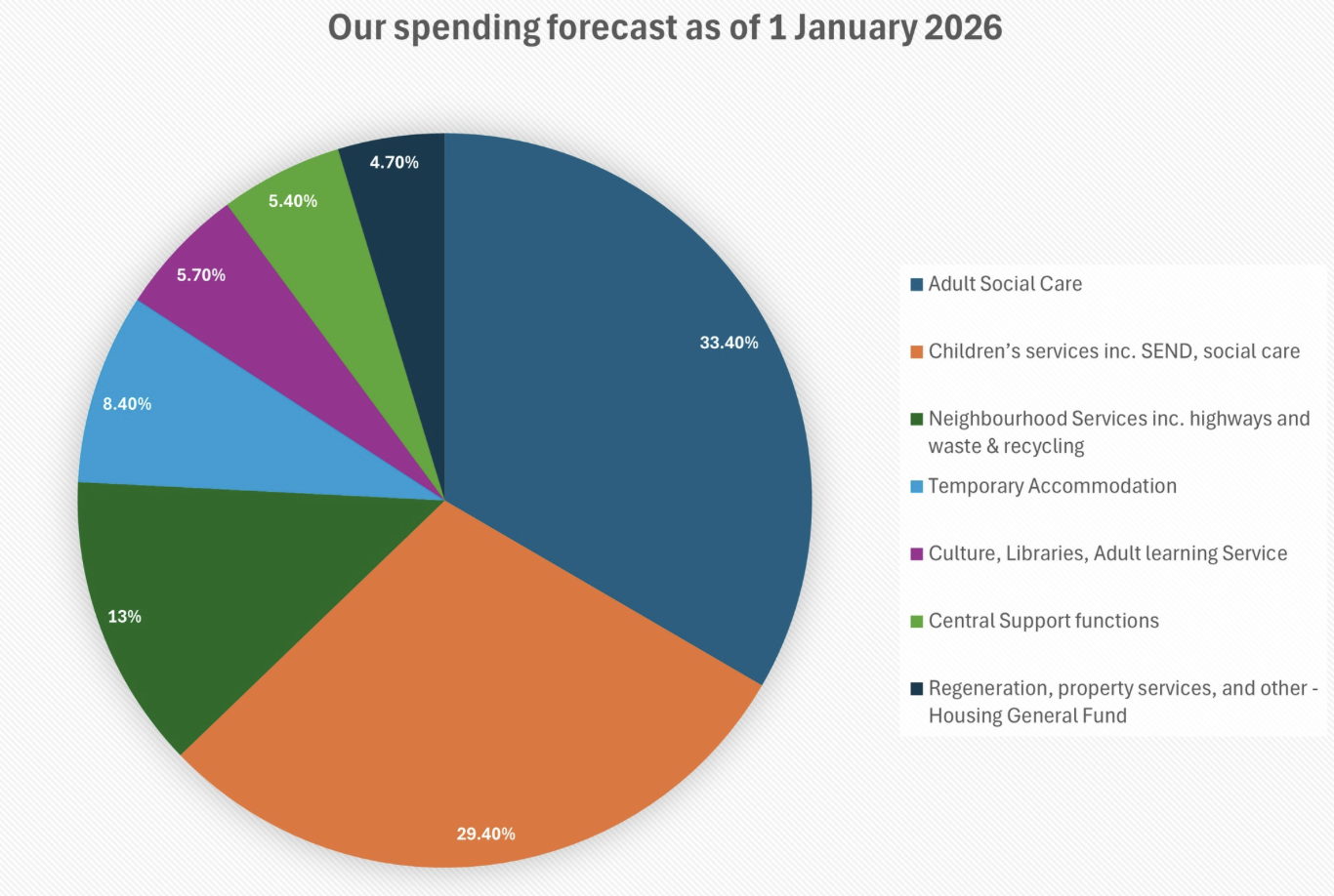
But they haven’t spelt that out, nor is it clear how it could be done to any great extent without damaging those most in need of assistance, as this pie chart makes clear:
Thus, the Greens silence about finance is puzzling. All of the data cited in the preceding paragraphs has long been in the public domain, so they could have accessed it just like anybody else.
Perhaps they disbelieved the published figures. Or perhaps they simply have got so carried away with their plans that they just overlooked their costs. Whatever the case, there undoubtedly is a big question mark about their competence.
One other policy area also gives cause for disquiet.
In their manifesto, the Greens make much of their commitment to being open and transparent, and involving residents in choices. But they do not go into much detail about the practicalities, and the worry, again, is that they have not grasped the full extent of the task.
There is certainly much ground to make up here, as over the last decade or so, Labour’s record has been woeful, and amongst other things involved:
(a) maintaining an unusually large PR apparatus, and prioritising ‘controlling the narrative’ when considering virtually every important decision;
(b) abolishing ward forums and community councils, which were independently chaired and allowed residents to directly question council officers and councillors over local issues;
(c) closely policing scrutiny committees and their minutes in order to discourage debate and critical questioning;
(d) failing to uphold the mandatory Local Government Transparency Code, with its requirements about publishing key information about the council’s activities;
(e) disregarding the Information Commissioner’s Office published standards over Freedom of Information Act and Subject Access requests; and
(f) allowing councillors to withhold information on their register of interests forms about their paid employment and property holdings.
The space exists, therefore, for the Greens to capitalise, and capitalise significantly, but strangely their manifesto completely ignores all of these various infelicities, let alone pledges to reverse them.
In fact, it’s as if they don’t know that this history even exists.
In conclusion, the Greens often talk about being honest.
If their manifesto really is honest, its contents hardly inspire confidence in their understanding of local government realities.
And if it isn’t honest, well, they will stand accused of misleading the electorate, in effect making promises to all and sundry which they know they cannot keep.
